
Our Vision
The Most Valuable Asset in Enterprise Software Is Disappearing
Every large enterprise runs on software it doesn't fully understand. Millions of lines of COBOL, PL/I, RPG, and legacy Java — systems that process trillions of dollars, underwrite policies, settle trades, and move goods — operate today because of knowledge that has never been written down. It lives in the minds of engineers approaching retirement, in undocumented code paths, in workarounds that became workflows, and in tribal memory that erodes with every departure.
But the knowledge problem runs deeper than code. Around every legacy system is an ecosystem of human processes — manual handoffs, escalation paths, operational workarounds, business rules that exist only in a senior analyst's head — that are equally undocumented and equally critical. The code is the artifact. The real system is the code, the data, the processes, and the people, taken together.
This institutional knowledge is the most valuable and most fragile asset in enterprise software — and it is the key that unlocks transformation. Without it, every modernization is a guess. With it, an enterprise can see the full landscape of business outcomes available to it, choose a path, and execute against a verified specification at a speed and cost that was previously impossible.
The industry has no systematic way to capture this knowledge, turn it into actionable specifications, and drive transformation from it. Glover is building that system.
Why Now
Frontier AI models can now deeply reason about legacy languages — and we've seen it firsthand. For over a year, Glover has been building on the remarkable capability of large language models to read, analyze, and reason about COBOL, PL/I, RPG, and other legacy languages at a depth that was previously unimaginable. What was our founding insight has now become an industry narrative, as frontier labs have begun publicly demonstrating what's possible. The analysis bottleneck that made every legacy assessment slow, expensive, and incomplete has been broken open.
But as enterprise practitioners are quick to recognize, reading code is not modernizing it. The hard work is data architecture redesign, process mapping, product strategy, and — critically — connecting business outcomes to modernization paths. AI solved the reading problem. What's still missing is the contextual and coordination layer that synthesizes code, data, processes, and human knowledge into structured specifications — and then drives transformation against them with agentic AI, purpose-built workflows, and human oversight only where it matters.
The window is open. The models are capable. The enterprises are ready. What they need is the system that turns understanding into outcomes. That's Glover.
What We Believe
Understanding before action.
The most expensive mistake in modernization is acting on incomplete understanding. Every dollar spent transforming a system you don't fully understand compounds risk. Glover's first job is always to build a complete, verified picture — because that picture is what makes rapid, low-risk transformation possible. Understanding isn't the destination. It's the launchpad.
Software is only half the system.
Any modernization that ignores the human processes surrounding the software will reproduce complexity rather than eliminate it. Glover captures how organizations actually operate — not just what the code says — because that's where modernization projects historically fail.
The spec is the durable layer.
Coding agents are commoditizing rapidly. Enterprises will choose models based on vendor relationships, sovereignty requirements, and performance. The structured understanding of what exists, what it means, and where it's going — the Living Specification — is the layer that retains value regardless of which models execute against it. We have strong opinions about specifications and workflows. We are deliberately unopinionated about which model does the work.
Data is not an afterthought.
Decades of business logic are encoded not just in application code but in database schemas, stored procedures, and data structures that predate modern architectural patterns. A transformation that moves the application but leaves the data behind — or moves the data without understanding the logic buried in it — is an incomplete transformation. Glover treats data migration as a first-class problem, not a downstream cleanup.
Auditability earns trust.
Regulated enterprises don't adopt tools that can't explain their decisions. Every inference Glover makes carries rationale and source citations. Every decision is recorded, versioned, and reviewable. This is how you build a product a CISO and CTO will sign off on — not just evaluate.
Where We're Headed
We envision a world where any enterprise can point Glover at a legacy estate and, with minimal effort, achieve a complete transformation — from first assessment to running on a modern stack.
Not as a multi-year program staffed by hundreds of consultants, but as a streamlined process that a product owner, business analyst, or IT leader can drive directly. Engineering teams focus on the decisions that matter. Glover handles the rest.
It starts with assessment — and assessment is where most modernization efforts succeed or fail. Glover doesn't just map what exists. It maps what exists in the context of what you're trying to achieve. The business outcome drives the specification, not the other way around.
The outcomes are as varied as the enterprises pursuing them: migrating off a mainframe to eliminate licensing costs. Modernizing the front end while preserving the mainframe core. Swapping from one platform vendor to another. Preparing legacy systems to communicate with modern agentic services. De-risking the loss of retiring COBOL talent. Readying a business unit for divestiture. Integrating a newly acquired system into an existing technology portfolio. Each of these is a different target state, a different transformation path, and a different set of trade-offs — and Glover's assessment phase produces a specification shaped by that specific outcome, with the full path decomposed, costed, and actionable.
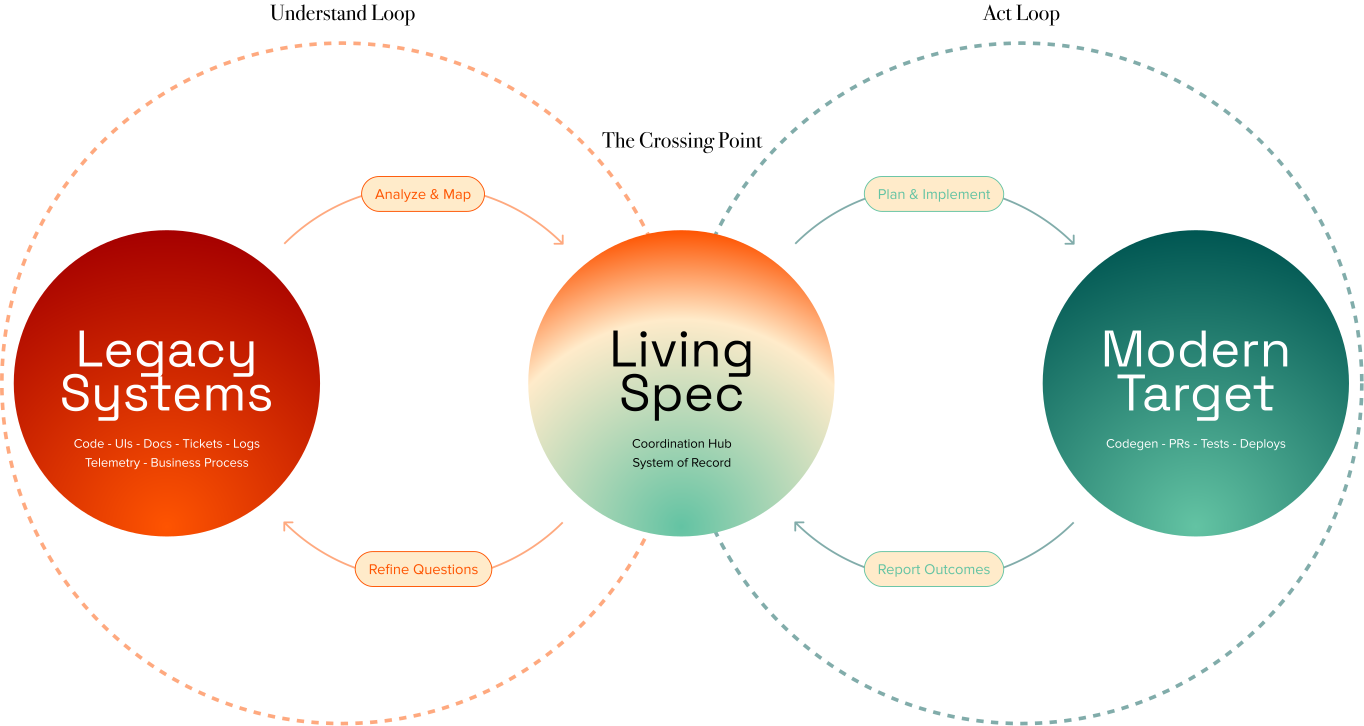
From there, execution is continuous and increasingly autonomous. Structured specifications flow into coding agents with full context. Data migration runs alongside application transformation. Human processes are simplified or retired where the assessment reveals they should be. People stay in the loop for major architectural decisions and business-critical approvals — but the default mode is autonomous execution against a verified spec, not manual oversight of every step.
Because the Living Spec captures context in structured, readable form, the people governing transformation don't need to be engineers. Product owners approve business logic migration. Domain experts validate process changes. Compliance officers audit decision trails. Each role operates through purpose-built workflows with full traceability.
Over time, the platform deepens with every engagement — capturing patterns, anti-patterns, and institutional context that make each subsequent transformation faster, cheaper, and more reliable. Legacy systems stop being liabilities and become assets enterprises can strategically evolve — swiftly, at low cost, and at low risk.
Where We're Investing
We are making five foundational bets. Each builds on the last.
Structured Understanding at Scale
Everything starts with a complete, verified model of what exists. Glover ingests source code, UIs, databases, documentation, tickets, logs, and telemetry — building a holistic knowledge layer that maps the full estate. This becomes the Living Specification: a versioned, queryable, auditable system of record that maintains the relationship between current-state reality and a configurable target architecture. The gap between where you are and where you're going is always quantified — in coverage, in understanding, and in dollars. From the Spec, Glover surfaces the business outcomes available to the enterprise and generates target-state specifications that agents and humans can execute against immediately.
Human Process and Knowledge Capture
The code is never the complete picture. Decades of operational reality live in the people and processes surrounding legacy systems — the undocumented escalation paths, the manual workarounds, the business rules that exist only in someone's head. Glover conducts AI-powered structured interviews and Q&A sessions with subject matter experts to extract tribal knowledge before it retires, observes how teams actually operate day-to-day, and maps these human processes into the Living Spec alongside the technical analysis. The result is a complete model of the system as it truly operates — not just as the code describes it. This is the gap that has historically caused modernization projects to migrate the software and lose the context.
Data Migration and Buried Logic Extraction
Legacy data stores — DB2, IMS, VSAM, and mainframe-era schemas — contain decades of business logic encoded in data structures, stored procedures, and table relationships rather than in application code. Glover analyzes, extracts, and migrates this data alongside the application: mapping buried business logic out of legacy data layers, restructuring it for modern targets like Snowflake, Databricks, or cloud-native data platforms, and ensuring that no business rules are lost in translation. The result is a complete migration — application, process, and data — to a modern stack where logic lives where it belongs.
Coordinated Agent Automation
Understanding without action is documentation. Glover's figure-8 architecture coordinates two agent loops through the Living Spec: one that continuously deepens understanding, and one that acts on that understanding to generate code, tests, and deployable artifacts. Every outcome and blocker feeds back into the Spec, creating a flywheel where execution improves understanding and understanding improves execution. A Modernization Command Center gives enterprise leadership real-time visibility into progress, decisions, blockers, and escalation points — the control surface needed to govern transformation at portfolio scale.
Enterprise Platform and Ecosystem
The coordination architecture is designed to scale across customers, portfolios, and partners. Glover integrates deeply with the modern platforms enterprises are migrating toward — Guidewire, Snowflake, ServiceNow, Salesforce, Databricks, and others — serving as the bridge between legacy reality and the target stack. Systems integrators bring domain expertise and customer relationships; Glover provides the platform that makes their engagements dramatically faster and more reliable. Industry-specific accelerators for financial services, insurance, healthcare, and government reduce time-to-value for the verticals where legacy concentration is highest.